what does car title look like
At some point in every vehicle owner’s life, a car title becomes one of the most important documents they will ever handle. Whether you are buying a used car from a private seller, selling your own vehicle, transferring ownership after a gift or inheritance, or simply trying to figure out whether your paperwork is complete, knowing exactly what a car title looks like — and what every section means — is essential.
The problem is that most people only encounter a car title a handful of times in their lives, which means the document can look confusing or unfamiliar when it finally appears. This guide walks through everything you need to know: the physical appearance of a title, what every field on the document records, how titles vary by state, what title brands mean, and how to use the document correctly when buying or selling a vehicle.
The Physical Appearance of a Car Title
A vehicle certificate of title is not a standard piece of printer paper. It is printed on security-grade paper similar in feel and construction to official government documents, and in many states it resembles the paper stock used for currency. The thickness, texture, and finish of a legitimate title are immediately distinguishable from a photocopy or a forgery.
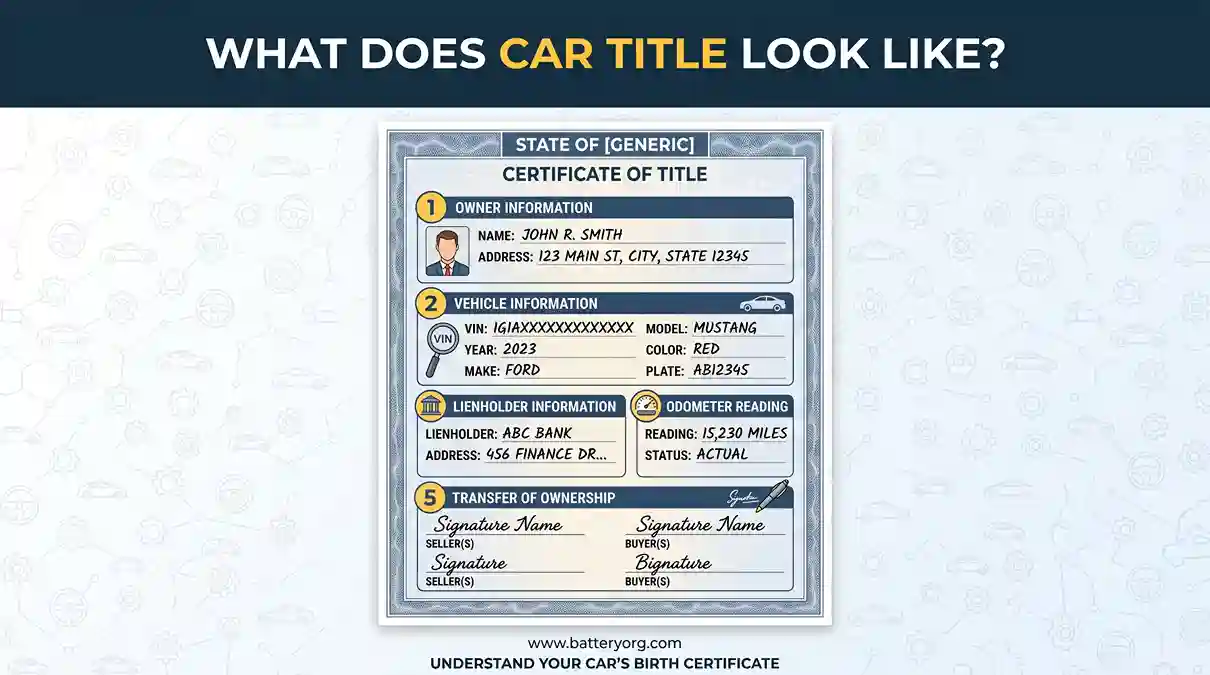
Most states print their titles in muted, official colors — blues, greens, and teals are common — with an intricate border design that functions as a security pattern. The state name and the words “Certificate of Title” or “Certificate of Ownership” appear prominently at the top. Many states also incorporate watermarks, serial numbering, or anti-copy features that cause the word “VOID” to appear across the document if it is photocopied.
The term “pink slip” — a common nickname for a car title — is largely historical. It originated in California, where titles were once printed on pink paper. Modern California titles are no longer pink, and the phrase now simply refers to the title document itself regardless of its actual color.
Because each state designs and issues its own title documents, there is no single universal appearance. A Texas title looks different from a Florida title, which looks different from a New York title. However, every state’s title must contain a standard set of information fields defined by federal and state law, which means the content is consistent even when the layout and design differ.
What Information Appears on a Car Title
Despite design differences between states, a standard car title contains the same core categories of information. Understanding what each field records is important both for verifying a title you receive and for filling one out correctly when you sell.
Vehicle Identification Information
The top section of most titles identifies the specific vehicle. This typically includes:
- Vehicle Identification Number (VIN) — The unique 17-character alphanumeric code that identifies your specific vehicle. This is the most critical field on the title. Always verify that the VIN on the title matches the VIN plate on the dashboard and the door jamb sticker of the physical vehicle.
- Year, Make, and Model — The model year, manufacturer name, and model designation as recorded at the time of manufacture.
- Body Type — Whether the vehicle is a sedan, pickup truck, SUV, convertible, or other body configuration.
- Color — The primary exterior color as recorded by the DMV.
- Fuel Type or Engine Details — Some states record the engine size, fuel type, or number of cylinders, particularly for older vehicles.
- Odometer Reading — The mileage at the time the title was issued or last transferred. Federal law requires odometer disclosure on title transfers for vehicles under ten years old and under 16,000 pounds.
Owner and Lienholder Information
The ownership section records who legally owns the vehicle and whether any financial institution holds a claim against it.
The registered owner’s full legal name and address appear clearly on the front of the title. If two people are listed as co-owners, pay close attention to the conjunction connecting their names. When the names are joined by “and,” both parties must sign for any transfer or transaction. When the names are joined by “or,” either owner can sign independently — a distinction that matters significantly in divorce situations, estate settlements, or any scenario where co-owners disagree.
If the vehicle is financed, the lender’s name and address appear in the lienholder section. This is the bank, credit union, or finance company that holds a legal interest in the vehicle until the loan is paid in full. A vehicle with an active lien cannot legally be sold or transferred to a new owner until that lien is released. Once the loan is paid off, the lender issues a lien release, and the title is considered clear.
Title Number and Issue Date
Every title carries its own unique title number — a reference number assigned by the state that allows the DMV to track that specific document in their records. The issue date indicates when the title was printed or last updated. These fields are used internally by the DMV and become relevant if you ever need to request a duplicate title or resolve a discrepancy.
What Title Brands Mean and Why They Matter
One of the most important things to examine on any car title is whether the vehicle carries a brand — an official notation printed directly onto the title that indicates a significant event in the vehicle’s history. Title brands are permanent. They follow the vehicle regardless of how many times it is sold or transferred between states.
Clean Title
A clean title means the vehicle has never been declared a total loss by an insurance company and carries no major brand designation. It is the most desirable title status for a used vehicle buyer. However, a clean title does not guarantee the vehicle has never been in an accident — it only means no insurer ever declared it totaled. A car can have significant repair history and still carry a clean title if the damage never reached the threshold for a total loss declaration.
Salvage Title
A salvage brand is placed on a title when an insurance company declares the vehicle a total loss — meaning the cost to repair the damage exceeds a defined percentage of the vehicle’s pre-damage value, typically between 75 and 90 percent depending on the state. A salvage-branded vehicle is not legally road-worthy and cannot be registered for normal driving until it is repaired and re-inspected by a state authority.
Rebuilt or Reconstructed Title
A vehicle that previously held a salvage title and has since been repaired to a standard deemed roadworthy by a state inspection earns a rebuilt or reconstructed title designation. These vehicles can be legally driven and registered, but the brand remains on the title permanently. Rebuilt-title vehicles are typically harder to insure at standard rates, and many lenders will not finance them. They often sell for significantly less than comparable clean-title vehicles, which can make them appealing to budget-conscious buyers who understand what they are purchasing.
Flood, Lemon, and Junk Designations
A flood brand indicates the vehicle sustained water damage serious enough to trigger a total loss declaration. Flood damage is particularly problematic because water intrusion into electrical systems and structural components can cause problems that surface months or years after the initial event, long after cosmetic repairs have made the car look fine.
A lemon brand — sometimes called a manufacturer buyback — marks a vehicle that the original manufacturer repurchased because it could not be repaired to meet warranty standards after a reasonable number of attempts. The federal Magnuson-Moss Warranty Act and individual state lemon laws govern these designations.
A junk or non-repairable title is the most severe designation. These vehicles are permanently barred from returning to the road and can only be used for parts or scrap. A junk-titled vehicle cannot legally be re-titled as a rebuilt vehicle in most states.
How Car Titles Look in Different States
While the content requirements are largely standardized, the visual appearance of a title varies considerably from state to state. If you are buying a vehicle that was previously titled in a state other than your own, the document will look unfamiliar — which is normal and not a cause for concern, as long as the content and security features appear authentic.
California Car Title
California titles feature a blue decorative border and display “STATE OF CALIFORNIA” and “CERTIFICATE OF TITLE” prominently at the top. The document is designed with anti-copy security features, including a pattern that produces a “VOID” watermark when photocopied. California titles clearly display any brand designation and include a separate section for the registered owner and legal owner (lienholder) when applicable.
Texas Car Title
Texas uses a color-coded system that carries meaning. An original Texas title is typically blue. A certified copy of a lost title is often brown. Texas titles are issued by the Texas Department of Motor Vehicles and include a remarks section where brand designations such as “Rebuilt” or “Salvage” are clearly printed. If you are buying a vehicle in Texas and the title color seems unusual, ask the seller to explain why they have a certified copy rather than an original.
Florida Car Title
Florida issues titles through the Florida Highway Safety and Motor Vehicles department. Florida is one of the states that has moved toward electronic title systems, where the title is held digitally by a lienholder rather than printed and mailed to the owner. If you are buying a financed Florida vehicle, the seller may not have a physical title in hand — the lien release process is completed electronically. Once a loan is paid off on a Florida title, a paper title is generated and mailed to the owner.
The Back of a Car Title: Transfer and Odometer Sections
The front of a title identifies the vehicle and its ownership. The back is where transactions happen. Most people never look at the back of a title until they need to use it, at which point a mistake in this section can create significant legal and logistical problems.
Assignment of Title (Seller’s Section)
The assignment section is where the current owner signs the vehicle over to a new buyer. It typically includes fields for the seller’s signature, the buyer’s name and address, the sale price, the date of sale, and the odometer reading at the time of the transaction. Every field must be filled in accurately and completely. Leaving any field blank creates what is sometimes called an open title or a floating title — a practice that is illegal in most states because it allows the vehicle to change hands multiple times without proper registration.
Never use correction fluid, make cross-outs, or attempt to erase anything on a title. Any alteration typically voids the entire document and requires the owner to apply for a replacement title before the transaction can proceed legally. Always use black or blue ink when completing title sections.
Odometer Disclosure
Federal law requires that the seller and buyer both certify the vehicle’s odometer reading at the time of transfer. The seller certifies that the reading is accurate to the best of their knowledge, and the buyer acknowledges that reading. If there is reason to believe the odometer has been tampered with or rolled back, there is a designated field for noting that the reading may not reflect actual mileage. Odometer fraud is a federal crime under the Truth in Mileage Act.
Lien Release Section
If the vehicle was previously financed and the loan has been paid off, the lender completes a lien release on the back of the title — or provides a separate lien release document — to certify that their financial interest in the vehicle has ended. Never purchase a vehicle where the lienholder has not formally released their claim. Buying a car with an unsatisfied lien means you could potentially lose the vehicle to the lender, even after you have paid the seller in full.
What to Do When Buying a Car: Title Checklist
Whether you are shopping for a reliable daily driver or considering one of the most reliable cars in 2026, reviewing the title carefully before any money changes hands is non-negotiable. Here is what to verify:
- The VIN on the title matches the VIN on the vehicle’s dashboard plate and door jamb sticker.
- The seller’s name on the title matches their government-issued ID exactly.
- There are no active liens unless the seller can document that the payoff will be handled at closing.
- The title carries no brand designation you were not told about and cannot accept.
- The odometer reading on the title is consistent with the reading on the dashboard and the vehicle’s service history.
- No corrections, white-out, or cross-outs appear anywhere on the document.
After completing a purchase, take the signed title to your state’s DMV or equivalent agency promptly — most states set a deadline of 10 to 30 days — to transfer registration into your name. You can find current title transfer requirements for your state by searching your state’s DMV website or using a quick Google search for your state’s title transfer process. Additional ownership and buying guidance is also available at BatteryOrg.
Lost or Damaged Car Titles
If a title is lost, stolen, or so badly damaged that it is illegible, you will need to apply for a duplicate title through your state’s DMV before you can sell the vehicle or complete most official transactions. The process involves completing a duplicate title application, paying a small fee, and providing proof of identity and vehicle ownership. Processing times vary from same-day service at some DMV offices to several weeks by mail.
If you are purchasing a vehicle and the seller does not have the title, proceed with extreme caution. A legitimate seller without a title should be able to apply for a duplicate through their state DMV before the sale is completed. A seller who is evasive about why the title is missing should be a significant red flag.
For electric vehicle owners, the title process works identically to conventional vehicles, though EV titles may include additional fields for battery capacity or charging specifications in some states. If you ever need to service your EV’s battery system and have questions about ownership documentation, practical maintenance guidance — including how to safely remove a car battery — is worth reviewing alongside your title documentation.
Title Washing: A Fraud Risk Every Buyer Should Know
Title washing is a practice where a vehicle with a damaging brand — typically salvage or flood — is registered in a state with looser branding requirements, effectively replacing the branded title with a cleaner-looking document. The vehicle is then sold to an unsuspecting buyer who believes they are getting a clean-title vehicle.
This is why running a VIN-based vehicle history report is essential for any used vehicle purchase, regardless of what the title shows. A history report pulls data from insurance companies, state DMV records, and law enforcement databases across multiple states, making it much harder for a washed title to hide a vehicle’s true history. If you buy a car and later learn that the title was washed, you have virtually no legal recourse against the seller in most states.
Frequently Asked Questions
What does a car title look like physically?
A car title is printed on thick, security-grade paper — not ordinary printer paper — and typically features an intricate border design, state branding at the top, and anti-counterfeiting features like watermarks or void patterns that appear when photocopied. Most states use muted colors such as blue, green, or teal. The document is roughly letter-sized and contains printed fields for vehicle information, owner details, and lienholder information on the front, with transfer and odometer sections on the back.
What is the difference between a clean title and a clear title?
These terms describe two different things. A clean title means the vehicle has never been declared a total loss or given a major damage brand like salvage or flood. A clear title means there are no outstanding financial liens against the vehicle — no bank or lender holds a claim against it. A car can have a clean title but not a clear title if it is still financed. Ideally, any used vehicle you purchase should have both a clean and a clear title.
Can a car title be handwritten or photocopied?
No. A car title is a government-issued legal document that must be the original printed document issued by the state. A photocopy or handwritten reproduction has no legal standing and cannot be used to transfer ownership. If the original title is lost, the owner must apply for a duplicate through their state DMV before any transaction can be completed.
What does it mean if a car title has two names on it?
Two names on a title indicate co-ownership. The conjunction connecting the names determines how decisions about the vehicle are made. If the names are connected by “and,” both owners must sign to sell or transfer the vehicle. If connected by “or,” either owner can sign independently. When buying a vehicle with two names on the title, ensure both listed owners are present or have provided a power of attorney authorizing one to act on behalf of both.
How long does it take to get a car title after buying a vehicle?
If you buy from a licensed dealership, they typically handle the title transfer on your behalf, and you receive the title within four to six weeks after the DMV processes the paperwork. In a private sale, you receive the signed title immediately and are responsible for submitting it to your state’s DMV yourself, usually within 10 to 30 days depending on your state. Processing time for a new title in your name can range from a few days to several weeks depending on the state and whether you apply in person or by mail.
Conclusion
A car title is far more than a piece of paper — it is the legal record of a vehicle’s ownership, history, and financial status. Knowing what a car title looks like, what every section records, and what warning signs to watch for protects you whether you are buying, selling, or simply trying to keep your records in order.
The physical document should look official and feel substantial, with visible security features and clear printed fields. The information on it should match the vehicle you are looking at and the seller you are dealing with. The back of the title should be completed accurately and in full with no alterations. And any brand designation — salvage, rebuilt, flood, or lemon — tells you something important about the vehicle’s past that you deserve to know before the transaction is complete.
Taking the time to understand your car title fully is one of the simplest and most effective things you can do to protect yourself in any vehicle transaction. Read it carefully, verify what it says against the physical vehicle, and never skip the step of running a VIN history report before you commit.