What Does Vehicle Registration Look Like? A State-by-State Guide
If you’ve ever dug through your glove compartment looking for “the registration” and weren’t quite sure what you were looking for, you’re not alone. Every state handles this a little differently, and that’s exactly why so many drivers end up Googling the question.
This guide walks through what vehicle registration actually looks like, what’s printed on it, how it differs from your title, and what to expect in states like Texas, California, and Missouri — three places where this question comes up constantly.
What Is Vehicle Registration, Exactly?
Vehicle registration is the process of recording your car with your state’s Department of Motor Vehicles (DMV) — or, in some states, a different agency entirely, like the county tax office in Texas or the Department of Revenue in Colorado. Once you register, the state gives you proof that your car is legally allowed to drive on public roads.
That proof takes a physical form, and this is where the confusion usually starts. Depending on where you live, it might be a small card, a full sheet of paper, a windshield sticker, or some combination of all three.
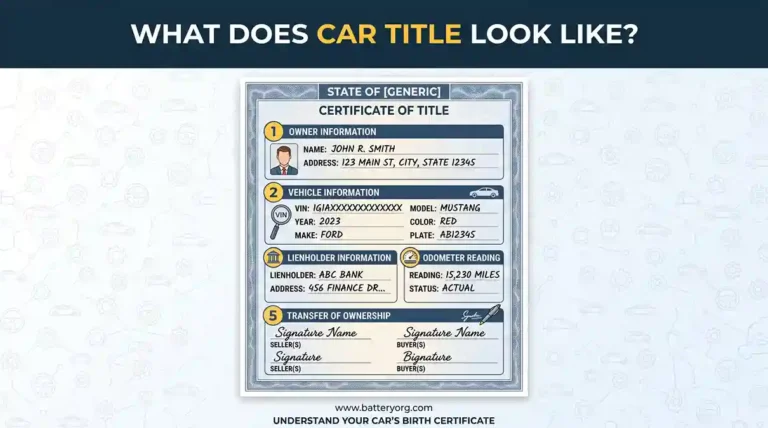
Registration is not the same thing as your title. Your title proves who legally owns the vehicle. Your registration proves the vehicle is currently authorized to be driven and that you’ve paid the required fees and taxes for the year. You need both, but they serve different purposes and usually look nothing alike.
What Does a Vehicle Registration Card Actually Look Like?
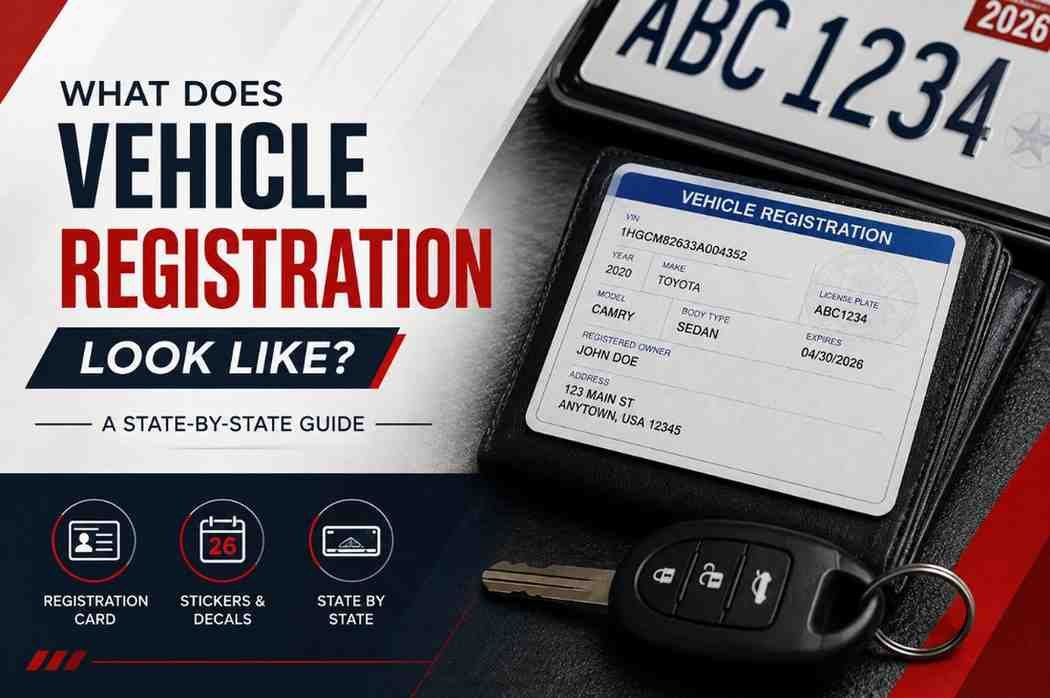
Most states issue something close to a wallet-sized card, similar in size and shape to a driver’s license, though a handful use a full-page document instead. Whatever the format, a typical registration card includes:
- Vehicle Identification Number (VIN) — the 17-character code unique to your car
- Year, make, and model of the vehicle
- License plate number
- Registered owner’s name and address
- Registration issue date and expiration date
- Vehicle class and body type
- Odometer reading (in states that require it at registration)
- Registration fee amount paid
- County or state seal or watermark
Some states, like New York, pair the card with a decal you place on your windshield. Others, like Texas, rely heavily on a colored sticker system instead of (or in addition to) a paper card. In New York, your registration is technically both the sticker placed on your windshield and the paper registration certificate you’re required to keep in the vehicle.
Registration Card vs. Registration Sticker vs. License Plate
People often lump these three together, but they’re not interchangeable.
Registration card or certificate — The paper or plastic document with your vehicle’s details. You’re generally required to carry this in the car at all times.
Registration sticker or decal — A small adhesive tag, usually placed on your license plate or windshield, showing the month and year your registration expires. Texas is the largest state to issue windshield stickers customized to the vehicle, with each sticker showing the owner’s license plate number, county of residence, and a partial VIN.
License plate — The metal plate itself, which you typically keep across renewals unless you move states or request a new plate design.
What Does Vehicle Registration Look Like in Texas?
Texas is one of the most-searched states for this exact question, so it’s worth breaking out separately.
<cite index=”Your Texas vehicle registration sticker displays your license plate number, county of registration, and a partial vehicle identification number, which helps protect against theft and fraud.</cite> You’ll place this sticker on your windshield, and since 2015, Texas combined the registration sticker and safety inspection sticker into a single sticker to simplify the process for drivers.
To register a vehicle in Texas, you’ll typically need to:
- Pass a state safety inspection (and an emissions test if you live in one of the designated counties, which include Harris, Dallas, Travis, and Tarrant, among others)
- Show proof of the state’s minimum required insurance coverage
- Visit your local county Tax Assessor-Collector office to receive your registration and sticker
<cite index=”14-1″>Texas requires vehicles in certain counties — including Brazoria, Collin, Dallas, Denton, El Paso, Ellis, Fort Bend, Galveston, Harris, Johnson, Kaufman, Montgomery, Parker, Rockwall, Tarrant, Travis, and Williamson — to pass an emissions test before applying for registration.</cite> Outside these counties, a safety inspection alone is usually enough.
What Does Vehicle Registration Look Like in Missouri?
Missouri issues a registration renewal notice along with plate tabs or a windshield decal, depending on your vehicle type. The registration document lists the plate number, VIN, vehicle description, and expiration date, and Missouri requires drivers to keep the paper registration inside the vehicle at all times, similar to most other states.
What Does a Vehicle Registration Card Look Like in California?
A California vehicle registration card looks similar to a driver’s license in size, but it includes details about your car rather than about you You’re required to keep it with you whenever you’re driving, just like your license.
California also requires proof of a passed smog inspection for most vehicles before you can register or renew, along with proof of insurance. Smog inspections are required when registering or renewing registration in California, though some vehicles are exempt, and insurance is mandatory for all vehicles operated or parked on California roads.
What Documents Do You Need to Register a Vehicle?
Requirements vary by state, but nearly every DMV asks for some version of the following:
- Proof of ownership — your vehicle’s title, or a lease agreement if the car is leased
- Proof of identity — driver’s license, state ID, or another government-issued ID
- Proof of insurance meeting your state’s minimum coverage requirements
- Odometer disclosure, usually required for vehicles under a certain age
- Payment for registration fees, sales tax (if applicable), and any local taxes
- Passed inspection results, where required — safety, emissions, or both
Renewing registration can often be done online, and if you’re simply renewing your current car, most of your previously supplied information carries over automatically, aside from an updated odometer reading in states that require one.
How Long Does Vehicle Registration Last?
Most states issue registration for either one year or two years, though a few offer multi-year options for an additional fee. Virginia, for example, typically issues registration for one year but allows drivers to renew for two or three years at a time if they’d prefer to skip the annual paperwork. Whatever your state’s cycle, your DMV will usually mail or email a renewal reminder before your registration expires.
Common Mistakes Drivers Make With Vehicle Registration
Letting registration lapse. Even a few days past your expiration date can result in a ticket in most states, and in some cases, your vehicle can be flagged during a routine traffic stop.
Mixing up title and registration. These are different documents that serve different legal purposes. Selling a car requires transferring the title, not just the registration.
Not updating your address. If you move and don’t update your registration, renewal notices and violation notices may go to your old address, and you could miss a deadline without realizing it.
Losing the physical card. Many states allow you to request a replacement online or through the mail, but driving without proof of registration can still result in a citation even if your registration is technically valid.
Assuming the sticker alone is enough. In states like Texas, the sticker and the paper card work together. Carrying only one isn’t always sufficient if an officer asks for documentation.
Digital Vehicle Registration: A Growing Option
A number of states now offer digital registration through DMV-issued apps or portals, letting you show proof of registration on your phone instead of carrying a paper card. Availability and legal acceptance of digital registration vary by state, so it’s worth confirming with your local DMV before relying on it exclusively, especially if you’re driving out of state, where digital proof isn’t always recognized.
Frequently Asked Questions
What does vehicle registration look like? It’s typically a small card or paper document listing your VIN, license plate number, vehicle description, and registration expiration date. Many states pair it with a windshield or license plate sticker showing the expiration month and year.
What’s the difference between a registration card and a title? The title proves ownership. The registration proves the vehicle is currently authorized to drive on public roads and that fees have been paid for the year.
What does a vehicle registration sticker look like in Texas? It’s a colored windshield sticker showing your license plate number, county, and a partial VIN, combined with your safety inspection sticker into one.
Do I need to carry my registration in the car at all times? Yes. Nearly every state requires you to keep your current registration document in the vehicle, and you can be cited for not having it available during a traffic stop even if your registration is valid.
Can I use a digital copy of my registration instead of a paper card? Some states allow this through official DMV apps, but acceptance isn’t universal, particularly across state lines. Check with your state’s DMV before relying on a digital-only copy.
What happens if I lose my registration card? Most DMVs let you request a replacement online, by mail, or in person, usually for a small fee. You’ll need your license plate number or VIN to process the request.
How do I know when my vehicle registration paper looks different from my car registration card? Some states, particularly Missouri and New York, issue a full-page paper certificate rather than a wallet-sized card. Both serve the same legal purpose — they just differ in format based on your state’s DMV system.
Final Thoughts
Vehicle registration might look a little different depending on which state issued it, but its purpose stays the same everywhere: proving your car is legally allowed on the road and that you’re up to date on the required fees and inspections. Knowing what to look for on your card, and keeping it current saves you from unnecessary tickets and headaches down the line.
If you ever need to double-check your car’s details for registration purposes, knowing where to find car VIN number on your vehicle makes the process faster. And once your registration is squared away, it’s worth brushing up on road signs and what they mean, since both go hand in hand with staying road-legal.