how long do batteries last in a car?
Few things are more frustrating than turning the key on a cold morning and hearing nothing but a slow, labored crank or worse, silence. Car battery failure is one of the most common reasons drivers call for roadside assistance, and most of those failures could have been anticipated if the owner had understood how long batteries typically last and what warning signs to watch for.
The answer to how long batteries last in a car is not a single number. It depends on the type of battery, the climate you drive in, your driving habits, and how well you maintain the vehicle’s electrical system. This guide covers all of it from the standard lifespan of a conventional lead-acid battery to the very different timeline of an electric vehicle’s high-voltage pack, along with everything you can do to get the most life out of whatever battery is under your hood.
Average Car Battery Lifespan
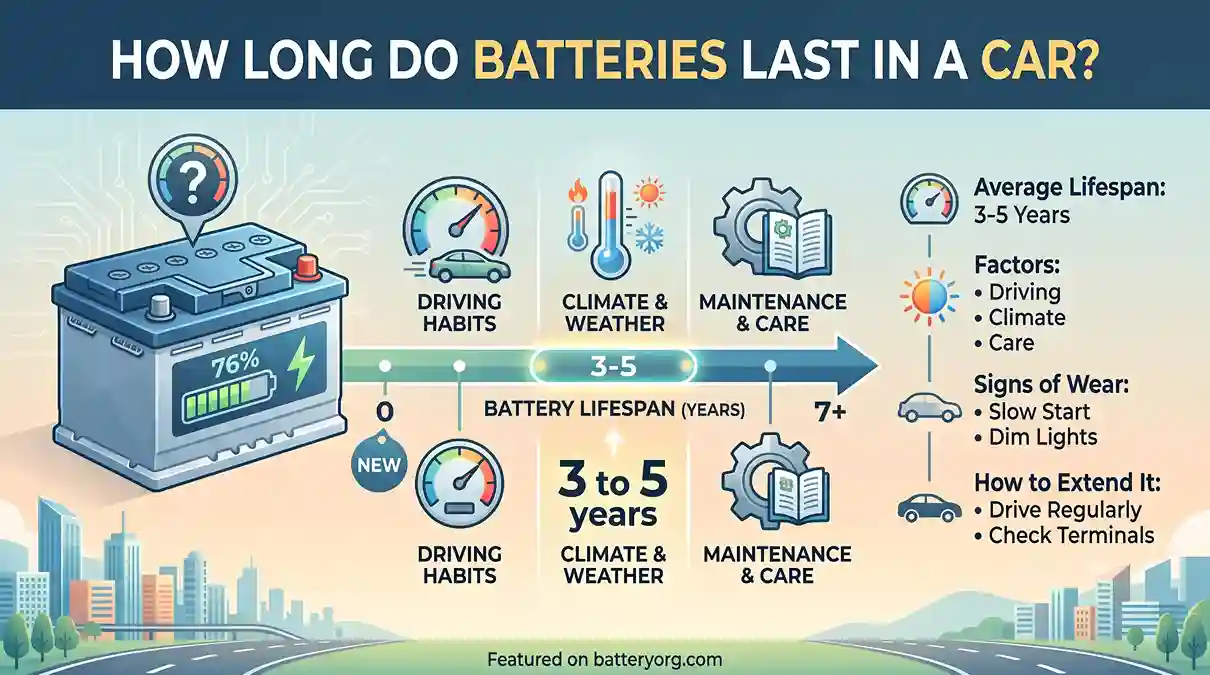
For a conventional 12-volt lead-acid battery the type found in the vast majority of gasoline and diesel-powered vehicles the generally accepted lifespan is three to five years. That is the range most mechanics, battery manufacturers, and automotive organizations like AAA use as a baseline when advising drivers on replacement intervals.
That said, three to five years is a guideline, not a guarantee. Batteries in hot climates often fail closer to the three-year mark because heat accelerates the internal chemical degradation that gradually strips a battery of its ability to hold a charge. Batteries in moderate climates with attentive owners have been known to last seven or eight years, though that is the exception rather than the rule. The variables are real and meaningful enough that treating your battery as a three-year consumable and having it tested annually after that point is a far more practical approach than waiting for it to fail.
Why Most Batteries Fail Between Years Three and Five
The chemistry inside a lead-acid battery is effective but not indefinitely durable. Each charge and discharge cycle causes a small amount of sulfation the buildup of lead sulfate crystals on the battery’s internal plates. Over time, this accumulation reduces the surface area available for the electrochemical reactions that produce current. The battery gradually loses cranking amps and its ability to hold a full charge until it can no longer reliably start the engine.
This process accelerates under heat, repeated deep discharging, and chronic undercharging. It is why a battery that survives two mild winters in good shape can still fail suddenly in its fourth summer the internal degradation has been building quietly the whole time.
Types of Car Batteries and How Long They Last
Not every car uses the same type of battery, and battery technology has diversified considerably as vehicles have become more electronically complex. Understanding which type of battery is in your car changes the conversation about expected lifespan.
Standard Flooded Lead-Acid Batteries
The most common type found in older vehicles and many basic modern cars. These are the least expensive option and typically last three to five years under normal conditions. They require some maintenance — periodically checking fluid levels in non-sealed versions — and are sensitive to deep discharging. If a standard flooded battery is repeatedly drained below 50 percent charge, its lifespan shortens significantly.
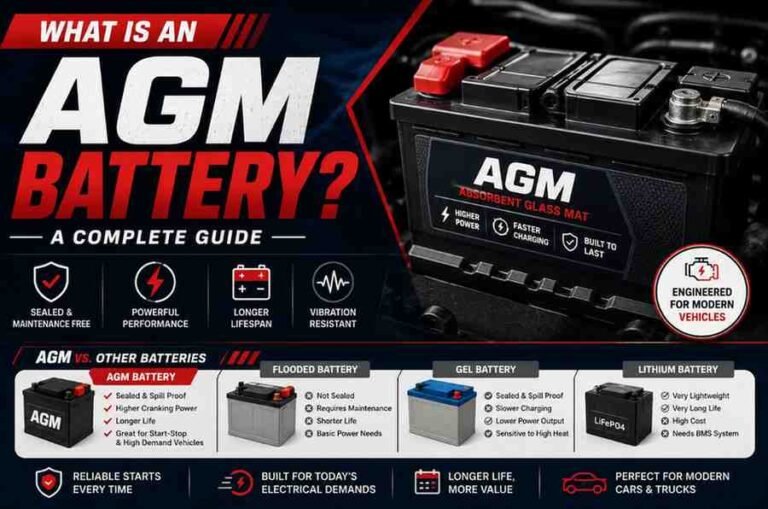
AGM (Absorbent Glass Mat) Batteries
AGM batteries are now standard in many modern vehicles, particularly those with start-stop engine systems, which shut the engine off at red lights to save fuel and restart it automatically when the driver releases the brake. This cycle happens dozens of times per commute, and a standard flooded battery would wear out quickly under that demand. AGM batteries are designed to handle deep discharges and frequent cycling more gracefully, and they typically last four to seven years — longer than conventional batteries under the same conditions.
They are more expensive to replace than flooded batteries, and they require AGM-specific chargers for proper maintenance. Using a standard charger on an AGM battery can damage it. If your vehicle originally came with an AGM battery, the replacement must also be AGM — swapping to a cheaper conventional battery in an AGM-equipped car can cause electrical problems because the vehicle’s charging system is calibrated for AGM’s different charging characteristics.
Lithium-Ion 12-Volt Batteries
A growing number of high-performance and luxury vehicles now use lithium-ion 12-volt batteries as their starting battery, separate from the main propulsion battery in hybrids and EVs. These are lighter, more powerful, and longer-lasting than lead-acid alternatives — often rated for eight to twelve years — but they are significantly more expensive and require compatible charging systems.
Electric Vehicle High-Voltage Battery Packs
The large lithium-ion battery pack that powers an electric vehicle’s drivetrain operates on an entirely different scale from a 12-volt starting battery. EV manufacturers typically warrant these batteries for eight to ten years or 100,000 miles, guaranteeing that the pack will retain at least 70 percent of its original capacity during that period. Real-world data and research from fleet operators suggest that most modern EV batteries last ten to twenty years before needing replacement, with an average annual degradation rate of approximately 2.3 percent.
That said, EV battery packs are subject to their own stressors. Frequent use of DC fast charging, consistently storing the battery at 100 percent or 0 percent state of charge, and prolonged exposure to extreme heat can accelerate degradation beyond the typical rate. Most EV manufacturers recommend keeping the battery charged between 20 and 80 percent for daily use to minimize long-term wear. It is worth noting that EVs also carry a conventional 12-volt auxiliary battery alongside the main pack — this smaller battery handles accessories, the computer systems, and vehicle startup, and it has the same three-to-five-year lifespan as a battery in any other car.
What Shortens a Car Battery’s Life
Understanding the factors that accelerate battery wear helps you make decisions that genuinely extend your battery’s useful life rather than simply hoping for the best.
Extreme Heat
Heat is the single greatest enemy of a conventional car battery. High temperatures increase the rate of internal corrosion, cause battery fluid to evaporate faster in non-sealed designs, and accelerate the chemical breakdown of the battery’s plates. Drivers in consistently hot climates — the American Southwest and Southeast, for example — should expect batteries to fall toward the lower end of the three-to-five-year range. Parking in a garage or covered structure during summer provides meaningful protection.
Cold weather gets more attention because it produces more dramatic symptoms — a failing battery that works adequately in summer may be unable to start the engine at 10 degrees Fahrenheit. But this is largely because cold temperatures slow the battery’s chemical reactions and reduce its output capacity. A battery that struggles in winter has usually accumulated damage during previous hot seasons. Cold weather reveals weakness; heat creates it.
Short Trips and Chronic Undercharging
Every time you start your car, the battery expends a burst of energy to fire the starter motor. The alternator — the component that generates electricity while the engine runs — then recharges the battery over the course of the drive. If your typical trip is five or ten minutes, the alternator may not have enough run time to fully restore what was consumed during startup. Over weeks and months of short-trip driving, the battery becomes chronically undercharged, and sulfation builds up on the plates faster than it would in a vehicle driven on longer trips.
This is a particular concern for city dwellers, people who drive to nearby workplaces, and anyone whose vehicle sits most of the week. If your driving pattern consists primarily of short trips, periodic longer drives — or occasional charging with a smart battery maintainer — helps compensate.
Extended Inactivity and Parasitic Drain
A car battery left in a parked vehicle will self-discharge over time, even with nothing turned on. Modern vehicles compound this with parasitic drain — a small but continuous current draw from computers, alarm systems, keyless entry modules, and other always-on electronics that need power even when the ignition is off. In a healthy vehicle with a healthy battery, this parasitic load is low enough that normal driving keeps the battery topped up. But if the car sits for several weeks without being driven, the battery can discharge deeply enough to cause sulfation or, in severe cases, discharge so completely that it cannot be recovered.
Vehicles stored for extended periods should be connected to a battery maintainer — a device that applies a low, continuous charge to keep the battery at optimal storage voltage without overcharging it. This is distinct from a standard battery charger, which is designed for faster charging and should not be left connected indefinitely.
Loose Connections and Corrosion
A battery terminal that is loose or coated in corrosion impedes the flow of electricity in both directions — when drawing current to start the engine and when accepting charge from the alternator. This disrupted charging relationship means the battery never fully recovers to peak charge after each start, which mimics the chronic undercharging effect of short trips and similarly accelerates sulfation. Inspecting and cleaning battery terminals is a simple maintenance task that takes minutes and costs almost nothing, yet it is routinely overlooked.
Warning Signs Your Car Battery Is Failing
Car batteries rarely fail without warning. The signals are often subtle at first and become progressively more obvious. Knowing what to look for means you can replace a battery on your schedule rather than on the side of the road.
- Slow or labored engine cranking — The starter motor sounds sluggish or takes longer than usual to turn the engine over. This is often the first and most reliable symptom of a battery losing cranking amps.
- Dimming headlights or flickering dashboard lights — Electrical components receiving less power than they need often manifest as visible brightness changes, particularly at idle when the alternator output is lower.
- A clicking sound when starting — A rapid series of clicks rather than a crank indicates the battery has enough charge to engage the solenoid but not enough to power the starter motor through a full rotation.
- Battery warning light on the dashboard — This light can indicate a battery problem, an alternator problem, or both. Either way, it warrants prompt diagnosis.
- Visible corrosion on terminals — White, blue, or gray powdery buildup around the battery terminals signals electrolyte leakage and an ongoing connection problem.
- A swollen or bloated battery case — Caused by excessive heat or overcharging, a swollen battery is a safety concern and should be replaced immediately.
- Needing frequent jump-starts — A battery that requires jump-starting more than once is not a battery that will be reliable. It is a battery that needs to be replaced.
If you notice any of these signs, most auto parts retailers — including AutoZone, O’Reilly, and Advanced Auto Parts — will test your battery for free while you wait. A battery load test measures the battery’s ability to deliver current under demand, which is a more meaningful assessment than a simple voltage reading.
How to Make Your Car Battery Last Longer
No battery lasts forever, but the gap between a battery that fails at three years and one that makes it to six is often a matter of consistent habits rather than luck.
Drive Regularly and Take Longer Trips When Possible
The alternator needs adequate run time to maintain a full charge. Aim for at least one trip per week of 20 to 30 minutes if your typical driving consists of short errands. If your vehicle sits for extended periods, use a smart battery maintainer rated for your battery type.
Turn Off Electronics Before Switching Off the Engine
Headlights, interior lights, and aftermarket accessories that remain on after the engine is off draw directly from the battery with no alternator to compensate. Make a habit of confirming everything is off before you leave the vehicle.
Keep Terminals Clean and Tight
Inspect the battery terminals every few months. If corrosion is present, clean it with a mixture of baking soda and water using a stiff brush, then rinse and dry thoroughly. Applying a thin layer of petroleum jelly to the clean terminals afterward slows future corrosion buildup. Confirm the terminal clamps are tight enough that the cables cannot be moved by hand.
Park in a Garage When Possible
Shielding the battery from extreme temperature swings — summer heat in particular — reduces the rate of internal degradation. A garage or covered parking structure is the most effective passive protection available.
Have the Battery Tested Starting at Year Three
Once your battery reaches three years old, include a battery load test as part of routine maintenance, even if the car is starting without issue. This gives you an early warning of declining capacity before the battery fails unexpectedly. Many shops include this check as part of a standard oil change inspection.
Understanding your battery’s condition connects to a broader picture of vehicle health. Just as you would verify a car’s VIN number to confirm its history before purchase, knowing your battery’s age and test results gives you a clear view of what maintenance is coming. And when it is time to replace the battery yourself, reviewing how to safely remove a car battery before you start saves time and prevents avoidable mistakes.
When to Replace vs. When to Recharge
Not every dead battery needs to be replaced. A battery that was fully discharged by leaving the headlights on overnight — but is otherwise healthy — can often be recharged with a quality smart charger and returned to full service. The distinction matters because a replacement battery costs anywhere from $100 to $300 or more depending on the type and group size, while a recharge costs nothing beyond the electricity.
The way to determine which situation you are in is a load test. If a fully recharged battery passes a load test — meaning it can deliver its rated cranking amps without the voltage collapsing — the battery is in serviceable condition. If it fails the load test even after a full recharge, it has reached the end of its useful life and should be replaced regardless of its age.
For those shopping for a vehicle where battery health is a concern, checking the car title for service history notes and asking for battery test documentation is worthwhile, particularly with used vehicles that have been sitting on a lot for an extended period. More automotive guidance for buyers and owners is also available at BatteryOrg’s road signs guide and across the broader resource library at BatteryOrg.
Frequently Asked Questions
How long does a car battery last on average?
The average lifespan of a conventional 12-volt car battery is three to five years under normal driving conditions. Batteries in hot climates or with infrequent use often fall toward the lower end of that range. AGM batteries, which are now standard in many modern vehicles, typically last four to seven years. Electric vehicle high-voltage battery packs are a different category entirely and generally last ten to twenty years.
Does leaving a car unused shorten battery life?
Yes. A parked vehicle continues to draw a small amount of current from the battery to power always-on electronics, even with the ignition off. If the car sits for several weeks without being driven, the battery can discharge deeply enough to accelerate sulfation and permanently reduce capacity. Using a smart battery maintainer during extended storage prevents this. Driving the car for at least 20 to 30 minutes once a week helps maintain an adequate charge under normal ownership.
Can extreme cold kill a car battery?
Cold weather significantly reduces a battery’s output capacity and increases the power demand needed to start a cold engine. A battery that is already weakened from heat damage or chronic undercharging will often fail its first severely cold morning. Cold weather does not typically cause healthy batteries to fail — it reveals batteries that were already degraded. A fully charged, healthy battery can withstand considerable cold without issue.
How do I know if my car battery or alternator is the problem?
Both can produce similar symptoms — difficulty starting, dim lights, and electrical issues. A simple way to distinguish them is to jump-start the vehicle and see what happens. If the car starts and runs normally after a jump-start and then starts fine on its own the next day, the battery was likely just discharged. If the car starts after a jump but dies again shortly after or the next time you try, the alternator may not be charging the battery properly. A battery and charging system test at an auto parts store will give you a definitive answer for both components simultaneously.
Should I replace my car battery before it fails?
Preventative replacement is a reasonable approach for drivers who cannot afford to be stranded. If your battery is approaching four years old and a load test shows it performing below 70 to 80 percent of its rated capacity, replacing it proactively is less disruptive and often cheaper than an emergency replacement with roadside assistance. If the battery is testing strong and you have no symptoms, there is no need to replace it purely based on age — but continue annual testing and remain alert to the warning signs described above.
Conclusion
How long batteries last in a car comes down to a combination of chemistry, climate, habits, and maintenance. For most drivers with a conventional vehicle, expecting three to five years from a standard battery and four to seven from an AGM is realistic. For electric vehicle owners, the main high-voltage pack should comfortably outlast most ownership periods, though the auxiliary 12-volt battery follows the same rules as any other car.
The most effective thing any driver can do is treat the battery as a monitored component rather than an invisible one. Have it tested once it reaches three years, keep the terminals clean, avoid letting the car sit for extended periods without maintenance charging, and pay attention to the early warning signs that something is changing. A battery that fails unexpectedly on a cold morning is almost always one that sent signals ahead of time — signals that were easy to miss because no one was looking for them.