How to Change a Car Battery Safely: A Step-by-Step Guide
A dead battery rarely picks a good time to fail. It’s the number one reason drivers call for roadside help in the United States, and vehicles between six and ten years old are the most likely to leave you stranded because of one. The good news: learning how to change a car battery is one of the simplest repairs you can do yourself, and most people finish the job in well under 30 minutes with nothing more than a wrench and a pair of gloves.
This guide walks through the entire process — from spotting the warning signs to torquing down the new terminals — and covers the things most other guides skip, like how to test your old battery before you buy a replacement, what a fresh battery actually costs in 2026, and how to change a car battery without losing settings on newer vehicles with onboard computers.
What You’ll Need
Before you pop the hood, gather these items so you’re not searching the garage halfway through the job:
- A new battery matched to your vehicle’s group size and cold cranking amp (CCA) rating
- Work gloves and safety glasses
- A socket wrench (usually 10mm) or an adjustable wrench
- A wire brush or dedicated battery terminal cleaner
- A small bowl or magnetic tray to hold bolts and washers
- Baking soda and water, mixed into a paste, for corrosion
- Anti-corrosion washers or dielectric grease (optional but helpful)
- A memory saver or OBD-II backup device (optional, for cars with electronic presets)
- A battery terminal puller (only if your cables are stuck)
Most of these are inexpensive and available at any auto parts counter, and stores like AutoZone, NAPA, and Advance Auto Parts will often lend specialty tools for free with a deposit.
Signs Your Car Battery Needs to Be Replaced
You don’t have to wait for a dead battery to strand you. Watch for these warning signs:
- Slow or sluggish engine cranking when you turn the key
- A clicking sound instead of the engine turning over
- Dim headlights or interior lights, especially at idle
- A battery warning light on the dashboard
- Corrosion — a chalky, greenish-white buildup around the terminals
- A swollen or misshapen battery case, often from heat exposure
- The battery is three years old or older. AAA recommends testing any battery once it hits the three-year mark, since most standard batteries fail somewhere between years three and five.
If you notice two or more of these signs, it’s worth testing the battery (more on that below) before you’re left calling for a tow.
How Long Does It Take to Change a Car Battery?
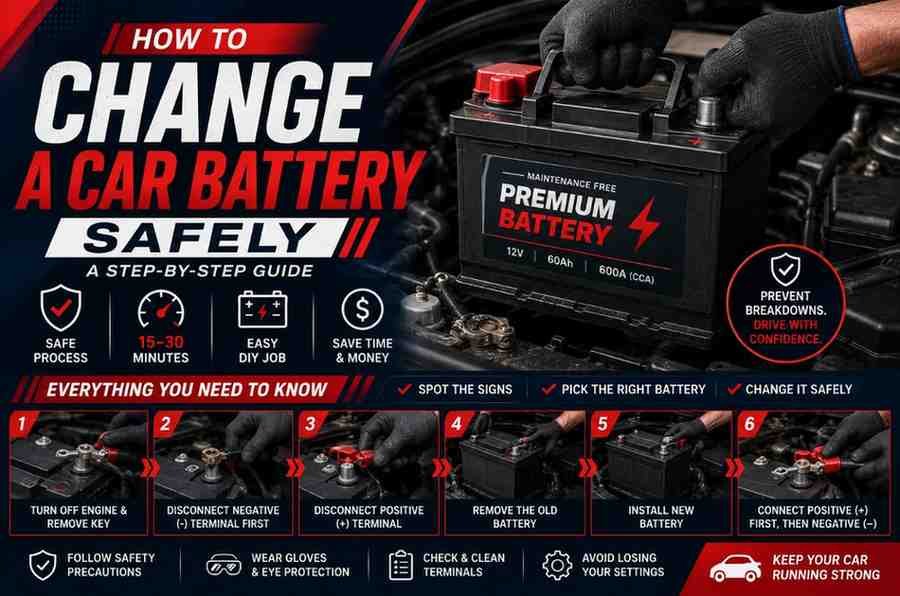
For most vehicles, changing a car battery takes 15 to 30 minutes once you have the right battery and tools on hand. Trucks and SUVs with easy under-hood access tend to go faster; European models with the battery buried under trim panels, or in the trunk, can take closer to 45 minutes. First-timers should budget a full hour to work carefully and double-check each connection.
Before You Start: Safety Precautions
Car batteries hold a real electrical charge and contain sulfuric acid, so a few precautions go a long way toward changing a car battery safely.
- Turn off the engine and remove the key before you begin, and let a recently driven engine cool for a few minutes.
- Wear gloves and safety glasses. Battery acid can cause chemical burns, and terminals sometimes carry residue on top of the case.
- Never let a metal tool touch both terminals at once, or touch a terminal to any grounded metal part of the car. This can cause sparks, a short circuit, or a small explosion from the hydrogen gas batteries release.
- Keep flames, cigarettes, and sources of sparks away from the work area.
- Remove jewelry like rings, watches, and bracelets that could accidentally bridge a connection.
- Note your radio presets, clock, and seat memory settings, or plug in a memory saver, if you want to know how to change a car battery without losing settings on a newer vehicle. Many modern cars store this information in volatile memory that clears the moment power is cut, and some European makes even require the battery management system to be reprogrammed after a swap.
Step-by-Step: How to Change a Car Battery
Here’s exactly how to change a battery in a car, whether you’re working on a compact sedan or a full-size truck. The core sequence is nearly identical across makes and models.
Step 1: Park and Prep the Vehicle
Park on level ground, shift into park (or first gear/neutral with the parking brake engaged for manual transmissions), and switch off the ignition. If you’re on an incline, chock the wheels for extra security.
Step 2: Locate the Battery and Identify the Terminals
Open the hood and find the battery. Most vehicles keep it in the engine bay, but some — particularly certain BMW, Mini, and Mercedes-Benz models — mount it in the trunk or under a rear seat. Check your owner’s manual if you can’t spot it right away.
Once you’ve found it, identify the two terminals. The positive terminal usually has a red cover or a “+” stamped into the case; the negative terminal is marked with a “-” and is often black.
Step 3: Disconnect the Negative Terminal First
This is the single most important safety rule when changing a car battery: always disconnect the negative (black) terminal before the positive one. Doing it in this order prevents your wrench from accidentally grounding the positive terminal against the car’s frame, which could cause a dangerous spark.
Loosen the terminal nut with your wrench, then gently twist and lift the cable clamp off the post.
Step 4: Disconnect the Positive Terminal
Repeat the same process on the positive (red) terminal. Set both cables aside so they can’t swing back and touch the posts while you’re working.
Step 5: Remove the Old Battery
Locate the hold-down clamp or bracket securing the battery to its tray and remove the bolt or wing nut holding it in place. Car batteries typically weigh 30 to 60 pounds, so lift with your legs, use the handle if there is one, and keep the battery level to avoid spilling any electrolyte.
Step 6: Clean the Battery Tray and Cable Terminals
With the battery out, inspect the tray for corrosion or debris. Mix a small amount of baking soda with water to form a paste, and scrub the tray and the inside of the cable clamps with a wire brush. Wipe everything dry — moisture left behind can interfere with the new connection.
Step 7: Install the New Battery
Set the new battery in the tray, making sure the positive and negative terminals line up on the same sides as before. Reinstall the hold-down clamp and tighten it snugly; a loose battery can vibrate loose over time and damage the terminals or the case.
Step 8: Reconnect the Terminals — Positive First
Reverse the disconnection order: attach the positive (red) cable first, tighten the nut until it’s snug, and then connect the negative (black) cable. If you have anti-corrosion washers or dielectric grease, apply them now to slow future corrosion.
Step 9: Test the Connection
Give the battery a gentle wiggle to confirm it’s secure, then start the engine. It should turn over normally. If you used a memory saver, disconnect it once the engine is running. Check that your dashboard clock, radio, and any electronic presets are behaving as expected, and reset anything that needs it.
How to Test Your Car Battery With a Multimeter
Before you spend money on a new battery, it’s worth confirming the old one is actually the problem — sometimes a weak alternator or a parasitic electrical drain is the real culprit. A basic digital multimeter, which costs about $15 to $20, tells you what you need to know in under five minutes.
- Set the multimeter to DC voltage (usually the 20V range).
- With the engine off and the car untouched for at least an hour, touch the red probe to the positive terminal and the black probe to the negative terminal.
- Read the display.
Here’s how to interpret the resting voltage:
- 12.6 volts or higher: Fully charged and healthy
- 12.4–12.5 volts: Moderately charged, generally fine
- 12.0–12.3 volts: Low charge; try recharging before replacing
- 11.8 volts or lower: Weak battery, likely near the end of its life
For a fuller picture, start the engine and test again. A healthy charging system should show 13.6 to 14.7 volts, which confirms the alternator is doing its job. If the resting voltage is low but the running voltage looks normal, the battery itself may simply need a full charge rather than a replacement.
Choosing the Right Replacement Battery
Not every 12-volt battery fits every car. Manufacturers rely on standards set by Battery Council International (BCI) to keep sizing consistent, and matching these specs matters as much as picking a trusted brand.
- Group size refers to the battery’s physical dimensions and terminal layout. Common sizes include 24, 35, 48 (H6), 65, and 94R (H7). Your old battery’s label — or your owner’s manual — will list the correct one.
- Cold cranking amps (CCA) measure how many amps a battery can deliver for 30 seconds at 0°F while staying above 7.2 volts. Higher CCA ratings mean easier starts in cold climates and heavier-draw vehicles.
- Reserve capacity (RC) indicates how long the battery can run essential systems if the alternator fails.
Battery chemistry also affects lifespan and price:
| Battery Type | Typical Lifespan | Best For | Approx. Price Range |
|---|---|---|---|
| Flooded lead-acid | 3–5 years | Most everyday cars and trucks | $100–$200 |
| EFB (Enhanced Flooded Battery) | 4–6 years | Entry-level stop-start vehicles | $150–$250 |
| AGM (Absorbed Glass Mat) | 4–7 years | Stop-start systems, heavy electronics | $200–$400 |
| Lithium-ion | 8–20 years | Performance and specialty vehicles | $300 and up |
Example: A driver in a hot climate like Phoenix, where summer heat accelerates internal corrosion, might see a standard flooded battery wear out in as little as two to three years — even though the same battery could easily last five years in a milder region. If that describes your situation, paying more for an AGM battery built to handle heat and vibration can be worth it long-term.
How Much Does It Cost to Change a Car Battery?
A professionally installed battery typically runs $100 to $300 in the U.S., including the part and labor, with premium AGM batteries and dealership installation pushing that closer to $400. Doing it yourself saves roughly $30 to $150 in labor, and many auto parts stores will even install the battery for free if you buy it from them.
If you’d rather leave it to a professional, it helps to come prepared. Bring your driver’s license and, if the shop needs to confirm your vehicle’s details against their system, your vehicle registration. If you’ve never had to check what does vehicle registration look like in your state, it’s typically a small card or printed form kept in the glove compartment alongside your proof of insurance.
Common Mistakes to Avoid
Even a simple job like changing a car battery has a few ways to go wrong:
- Disconnecting the positive terminal first. This raises the risk of a short circuit if your wrench brushes any grounded metal.
- Letting a wrench bridge both terminals. Always work on one connection at a time.
- Buying the wrong group size or CCA rating. A battery that physically doesn’t fit, or can’t deliver enough starting power, will cause problems fast.
- Skipping the corrosion cleanup. Reinstalling a battery onto a corroded tray or dirty terminals leads to poor connections and premature failure.
- Leaving the hold-down clamp loose. Vibration from driving can crack the case or loosen internal components over time.
- Forgetting about onboard electronics. Some vehicles need a scan tool to reset the battery management system after a swap, particularly certain German makes. Check your owner’s manual if your dashboard shows unusual warnings afterward.
- Tossing the old battery in the trash. It’s illegal in most states and genuinely hazardous.
What to Do With Your Old Battery
Car batteries are almost entirely recyclable, and federal and state laws require proper disposal because of the lead and sulfuric acid inside. Nearly every auto parts store — including AutoZone, NAPA, and Advance Auto Parts — will accept your old battery for recycling, and many even offer a small core credit toward your new one. For a full breakdown of drop-off locations, state-by-state rules, and what to do if a battery is leaking, see our guide on how to dispose of batteries.
Frequently Asked Questions
Which terminal do I disconnect first when changing a car battery? Always disconnect the negative (black) terminal first, then the positive (red) one. Reverse the order when reconnecting — positive first, negative last. This sequence reduces the risk of a short circuit.
How long does it take to change a car battery? Most drivers finish in 15 to 30 minutes. Vehicles with the battery in an unusual location, like the trunk, can take up to 45 minutes.
Can I change a car battery myself without losing my radio presets or clock settings? Yes, if you use a memory saver device plugged into the OBD-II port or the cigarette lighter before disconnecting the battery. Without one, most vehicles will reset the clock and may clear radio presets, though your engine computer typically relearns its settings within a few miles of driving.
How do I know what size battery my car needs? Check the label on your current battery for its BCI group size, or look up your vehicle by year, make, and model at any auto parts retailer. Your owner’s manual also lists the recommended group size and CCA rating.
Is it safe to touch a car battery with bare hands? It’s not recommended. Battery terminals can carry corrosive residue, and the acid inside is hazardous if the case is cracked or leaking. Gloves and safety glasses are cheap insurance against a nasty burn.
Can a car battery be recharged instead of replaced? Sometimes. If a multimeter shows low voltage but the battery is otherwise healthy, a full charge with a standalone charger can restore it. But if the battery is more than five years old or fails a load test, replacement is the more reliable fix.
Do I need to reset anything after installing a new battery? Usually just your clock and radio presets. Some newer vehicles, especially those with stop-start technology or advanced battery management systems, may need the system to register the new battery electronically — check your owner’s manual or ask your dealer if the battery light stays on.
Final Thoughts
Changing a car battery is one of the most approachable repairs a driver can tackle, and doing it yourself can save real money over a shop visit. Work through the steps in order, respect the negative-first, positive-first rule, and take the extra few minutes to clean corrosion and test your connections. Do that, and your new battery should give you several trouble-free years before you’re back under the hood again.