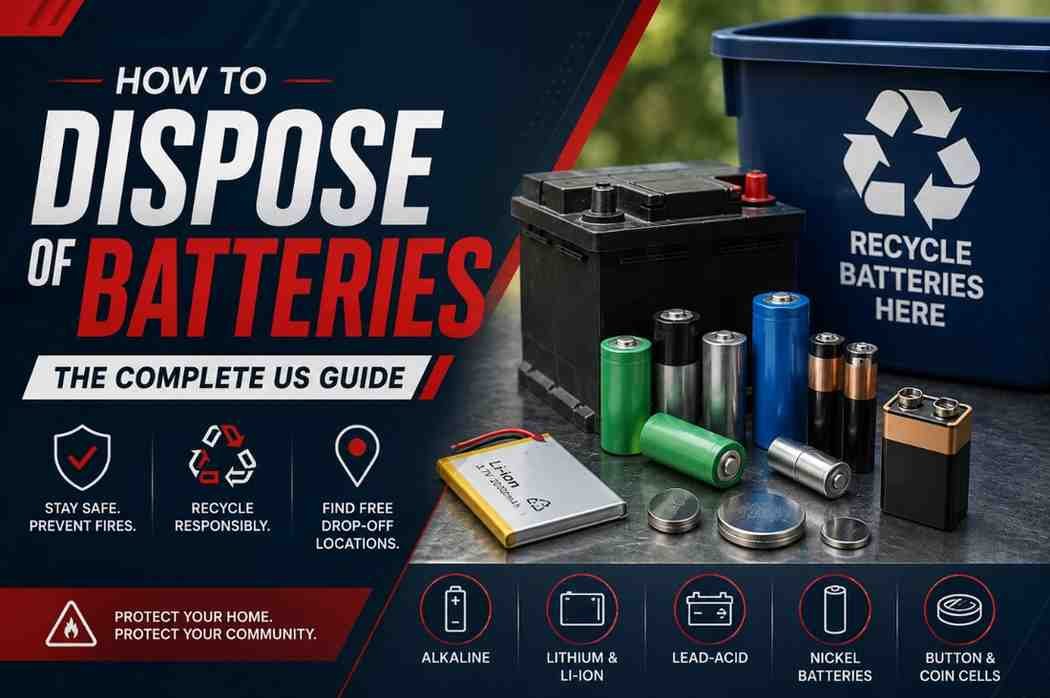
How to Dispose of Batteries: The Complete US Guide
Dead batteries pile up fast. A few from the remote, some from the kids’ toys, an old laptop pack in the junk drawer, maybe a car battery sitting in the garage. Most people just want to know where all of it should go without breaking any laws or starting a fire.
That last part isn’t an exaggeration. Lithium batteries tossed into curbside trash and recycling bins have become one of the leading causes of fires at waste facilities across the country, and the numbers have been climbing every year. Knowing how to dispose of batteries correctly protects your household, your local waste crews, and the environment.
This guide walks through every common battery type, the current state and federal rules, where to drop batteries off for free, and the mistakes that cause the most damage. Everything here reflects EPA guidance, state battery laws, and reporting from fire-safety and recycling industry groups current as of 2026.
Why You Can’t Just Toss Batteries in the Trash
It’s tempting to treat a dead battery like any other piece of household trash. Doesn’t work that way, and here’s why.
Battery Fires Are a Growing Problem
Fire Rover, a company that tracks fire incidents at waste and recycling facilities, recorded 448 publicly reported fires at US and Canadian recycling and waste sites in 2025 alone, causing more than $2.5 billion in damage. That’s a new record, up nearly 25% from the annual average between 2016 and 2021. The first two months of 2026 already produced 56 more fires, the highest February total since tracking began.
The cause, in most cases, traces back to lithium-based batteries. When a battery gets crushed, punctured, or overheated inside a garbage truck’s compactor or on a sorting line at a materials recovery facility, it can enter a state called thermal runaway. The cell heats uncontrollably and can ignite anything flammable nearby, from cardboard to plastic to paper.
The National Waste & Recycling Association estimates more than 5,000 fires occur annually at recycling facilities, with a growing share linked to lithium-ion cells. A 2025 survey from UL Standards & Engagement found that 36% of consumers admit to throwing old lithium-ion batteries straight into the trash, and another 30% mix them in with curbside recyclables. Neither is safe.
Environmental and Health Risks
Beyond fire, batteries contain materials that don’t belong in a landfill. Alkaline batteries have shifted away from mercury since the 1990s, but they still contain zinc and manganese that can leach into soil and groundwater over time. Lead-acid car batteries hold both lead and sulfuric acid, both hazardous if a casing cracks. Rechargeable batteries built with nickel-cadmium, nickel-metal hydride, or lithium-ion chemistries contain heavy metals and reactive materials that are far better recovered and reused than buried.
Recycling also recovers genuinely valuable resources. Lithium, cobalt, nickel, and graphite are classified by the federal government as critical minerals, meaning they’re economically important and difficult to source domestically. Every recycled battery reduces the need for new mining.
Know Your Battery Type Before You Dispose of It
The correct disposal method depends almost entirely on chemistry. Here’s a quick breakdown before we get into how to dispose of batteries step by step.
Alkaline batteries – Standard AA, AAA, C, D, and 9V batteries used in remotes, flashlights, and toys. Non-hazardous in most states today.
Lithium and lithium-ion batteries – Found in phones, laptops, power tools, e-bikes, vapes, and single-use lithium coin cells. High fire risk if damaged.
Lead-acid batteries – The heavy battery under your car’s hood, plus batteries used in boats, motorcycles, and backup power systems.
Nickel-cadmium (Ni-Cd) and nickel-metal hydride (Ni-MH) – Older cordless tools, some digital cameras, and rechargeable AA/AAA replacements.
Button and coin cell batteries – The small, round batteries in watches, hearing aids, key fobs, thermometers, and greeting cards.
How to Dispose of Batteries by Type
This is where most guides fall short, so here’s the detailed breakdown for each category.
How to Dispose of Alkaline Batteries (AA, AAA, 9V)
Single-use alkaline batteries are the one category where regular trash disposal is still legal in most of the country, since modern versions no longer contain mercury. That said, “legal” isn’t the same as “best.”
Steps:
- Tape the terminals of 9V batteries specifically, since their two contacts sit close together and can spark if they touch metal or each other.
- If your area allows trash disposal, place batteries in a small bag before adding them to household waste.
- If you’d rather recycle, check for a local household hazardous waste (HHW) drop-off or a retailer collection bin. Recycling doesn’t cost anything extra, it just takes a few more minutes.
California and Vermont are exceptions. Both states ban all battery types, including alkaline, from household trash. If you live in either state, alkaline batteries need to go to a designated collection point.
How to Dispose of Lithium and Lithium-Ion Batteries
This is the category that causes fires, so treat it differently from the rest.
Steps:
- Never place a lithium or lithium-ion battery in curbside trash or recycling, even in states without a formal ban. A single crushed battery in a garbage truck compactor can start a fire within seconds.
- Tape both terminals with electrical or clear packing tape to prevent short-circuiting during transport.
- Store used batteries in a cool, dry, non-metal container until you can drop them off.
- Take them to a retailer collection bin (Home Depot, Lowe’s, Best Buy, and Staples all participate), a household hazardous waste facility, or an electronics recycler.
- If a battery is swollen, leaking, or physically damaged, don’t tape and transport it yourself. Contact your local fire department or household hazardous waste program for guidance, since damaged lithium cells can ignite from mishandling.
This same process covers how to dispose of lithium-ion batteries from laptops, power tools, e-bikes, and vapes, along with how to dispose of a lithium coin or button cell used in key fobs and small electronics.
How to Dispose of Car Batteries (Lead-Acid)
Car batteries are, ironically, the easiest type to deal with responsibly. The lead-acid battery industry recycles roughly 99% of batteries collected each year, according to Battery Council International, making it the most recycled consumer product in the United States.
Steps:
- Take the old battery to any auto parts retailer, such as AutoZone, O’Reilly, or Advance Auto Parts, when buying a replacement.
- Expect a core charge refund, typically $5 to $20, since most states require a deposit on new lead-acid batteries that gets returned when you bring the old one back.
- Keep the battery upright during transport to avoid acid spills, and place it in a plastic tub or bag if the terminals look corroded.
- If you’re not buying a new battery right away, most retailers and scrap yards will still accept the old one, often for a smaller fee or credit.
Car batteries wear out on a predictable schedule, usually every three to five years, no matter which vehicle you drive, from an economy sedan to one of the most reliable SUV models on the market. If you’re getting rid of the vehicle itself rather than just the battery, it helps to know what a car title looks like so the paperwork transfers cleanly along with it.
How to Dispose of Button Batteries
Button and coin cell batteries deserve extra caution because of a risk that has nothing to do with fire: swallowing.
Reese’s Law, signed in 2022 after 18-month-old Reese Hamsmith died from swallowing a coin battery, now requires child-resistant compartments and stronger warning labels on products using these batteries. The Consumer Product Safety Commission enforces the standard.
Steps:
- Tape both flat sides of the battery with regular household tape. Poison Control specifically recommends this step because it prevents the battery from generating current if a child or pet swallows it, and it doesn’t interfere with recycling.
- Store taped batteries somewhere out of reach of children until you drop them off.
- Bring them to a household hazardous waste facility or a retailer participating in a battery take-back program.
- If ingestion is ever suspected, treat it as a medical emergency and seek immediate care. A swallowed button battery can burn through tissue in as little as two hours.
How to Dispose of Old or Swollen Batteries Safely
A battery that’s puffed up, warm to the touch, leaking, or has a cracked casing needs different handling than a normal dead battery.
- Move it to a fire-safe location away from anything flammable, ideally outdoors or in a metal container.
- Never puncture, crush, or attempt to tape a battery that’s actively leaking or extremely hot.
- Contact your local household hazardous waste program or fire department for pickup or drop-off instructions.
- Don’t ship a damaged battery through the mail. Carriers restrict damaged lithium batteries for safety reasons.
State Laws on Battery Disposal
Battery disposal rules vary more by state than almost any other type of household waste. As of 2026, roughly 18 states make it illegal to throw certain batteries in household trash, another 15 have specific recycling requirements, and the remaining states leave it up to local jurisdictions.
A few examples worth knowing:
- California bans all battery types from household trash, including alkaline AAs. It’s the strictest law in the country.
- Vermont operates an extended producer responsibility (EPR) program through The Battery Network and is expanding coverage to larger-format batteries like those in e-bikes.
- New York requires any retailer that sells rechargeable batteries to take them back for recycling.
- Washington, Illinois, Colorado, Connecticut, and Nebraska have all passed battery stewardship laws between 2025 and 2026 that shift collection costs onto manufacturers rather than consumers, with disposal bans phasing in between 2027 and 2028.
- Hawaii, Indiana, Louisiana, North Carolina, Texas, Wisconsin, and several other states specifically ban lead-acid batteries from landfills, even where other battery types aren’t regulated.
Because these laws change often, it’s worth checking your state environmental agency’s website or your city’s solid waste department before assuming your state has no rules. New Hampshire, for instance, banned lithium-ion battery disposal in general trash starting July 2025, a rule that didn’t exist just a couple of years earlier.
Where to Recycle Batteries Near You
Free battery recycling is more available than most people realize.
The Battery Network (formerly Call2Recycle) operates more than 30,000 drop-off points across the US, including bins inside Home Depot, Lowe’s, Staples, and Best Buy stores. Their online locator lets you search by ZIP code and filter by battery type, since not every location accepts every chemistry.
Auto parts retailers like AutoZone, O’Reilly, and Advance Auto Parts accept lead-acid car batteries year-round, usually with a core charge refund.
Household hazardous waste (HHW) facilities, run by counties or cities, accept nearly every battery type, including damaged or swollen ones that retail bins won’t take. Many offer scheduled collection events if there isn’t a permanent site nearby.
Electronics recyclers often accept batteries alongside old devices, which is convenient if you’re clearing out a drawer full of dead laptops and phones at the same time.
Before dropping batteries off anywhere, check the accepted-materials list for that specific location. Some sites take rechargeable batteries only, others handle single-use batteries too, and high-energy formats like e-bike batteries usually need a specialized program.
How to Prepare Batteries for Safe Disposal or Recycling
A little prep work goes a long way toward preventing fires and keeping your household safe in the meantime.
- Tape the terminals of 9V, lithium, and button batteries before storing or transporting them.
- Keep batteries in a non-metal, heat-resistant container rather than a loose pile in a drawer or bag.
- Store them away from direct sunlight and heat sources.
- Separate damaged or swollen batteries from healthy ones immediately.
- Never mix battery types loosely in the same container without terminal protection, since contact between two batteries can cause a short circuit.
Common Mistakes People Make When Disposing of Batteries
Tossing lithium batteries in curbside recycling. Recycling bins get compacted just like trash, and that mechanical pressure is exactly what triggers thermal runaway.
Assuming all batteries follow the same rule. A rule that applies to AA batteries in Texas doesn’t apply to AA batteries in California, and it definitely doesn’t apply to a lithium-ion pack anywhere.
Leaving loose batteries in a junk drawer for years. Corrosion and physical damage build up over time, raising the risk of leaks or short circuits.
Shipping damaged batteries without checking carrier rules. Postal and freight carriers have strict restrictions on damaged lithium batteries, and violating them can result in fines.
Not removing batteries from old electronics before recycling the device. Many e-waste recyclers ask for batteries to be removed and handled separately.
Frequently Asked Questions
Can I throw regular AA batteries in the trash? In most states, yes, since modern alkaline batteries no longer contain mercury. California and Vermont are exceptions and require recycling for all battery types. Recycling is still the better option everywhere, even where trash disposal is technically legal.
How do I safely dispose of batteries that are swollen or leaking? Move the battery to a fire-safe, non-metal container away from flammable materials, then contact your local household hazardous waste program. Don’t tape, puncture, or transport a leaking or hot battery yourself.
Where can I recycle lithium-ion batteries near me? Retailer bins at Home Depot, Lowe’s, Best Buy, and Staples accept most lithium-ion batteries through The Battery Network’s program. You can also use household hazardous waste sites or electronics recyclers.
Do I get money back for recycling a car battery? Usually, yes. Most states require a core charge on lead-acid batteries, typically $5 to $20, which gets refunded when you return the old battery to a retailer.
Is it illegal to throw batteries away in my state? It depends on the state and battery type. California bans all batteries from household trash, several other states ban specific types like lead-acid or lithium-ion, and some states have no restrictions at all. Check your state’s environmental agency website for current rules.
Why do lithium batteries cause fires in garbage trucks? Compaction inside a truck or sorting facility can crush or puncture the battery casing, triggering a chemical reaction called thermal runaway that generates intense heat and can ignite nearby materials.
What should I do with a button battery a child might have swallowed? Treat it as a medical emergency and seek immediate care. Button batteries can burn through tissue in as little as two hours if lodged in the esophagus.
Can I recycle batteries for free? Yes. Retailer collection bins, The Battery Network’s drop-off locations, and most household hazardous waste facilities accept batteries at no cost to consumers.
Final Thoughts
Battery disposal isn’t complicated once you know the category you’re dealing with. Alkaline batteries can usually go in the trash, though recycling is still better. Lithium, rechargeable, and button batteries need a proper drop-off point, taped terminals, and safe storage until you get there. Car batteries practically recycle themselves thanks to core charge incentives and a nationwide retailer network.
The extra few minutes it takes to tape a terminal or find a drop-off bin is small compared to the alternative: a truck fire, a contaminated landfill, or a child’s medical emergency. With state laws tightening every year, building the habit now saves both hassle and risk down the road.