How to Tell When Shocks or Struts Need Replacing
Knowing when to replace shocks or struts usually starts with the classic bounce test: push down hard on a corner of the car and watch how it settles. If it bounces more than once or twice before settling, that’s a real sign of wear. But the test has limits — a car can settle in one motion and still have a loose, wandering feel or dive hard under braking, and the bounce test alone won’t catch that.
Shocks and struts control how weight transfers when you brake, turn, or hit a bump. As they wear, that control degrades gradually, which is exactly why most drivers don’t notice until it’s significant. There’s no single moment where they fail outright, just a slow fade in how planted the car feels.
Signs beyond the bounce test
Uneven tire wear is one of the more reliable tells. Worn struts let the tire bounce slightly off the road surface at speed, wearing the tread in a cupped or scalloped pattern instead of evenly. If you’ve noticed that pattern during a tire rotation, it’s worth having the struts checked at the same visit.
Nose-diving under braking, body roll that feels more pronounced than it used to, and clunking over bumps are all worth paying attention to. So is a car that feels harder to hold in its lane on the highway — a worn strut lets the tire skip slightly on rough pavement, which shows up as steering that needs constant small corrections.
Why this affects your alignment
Struts are part of the suspension geometry itself, not just a damping component, so worn ones can throw off the angles an alignment is supposed to correct. Getting an alignment done on worn struts is a common way to waste money — the shop can dial in the geometry, but it drifts again as the worn parts keep moving more than they should.
A rough lifespan estimate is 50,000 to 100,000 miles for most passenger vehicles, though rough roads, towing, and hauling cargo shorten that considerably. That range is wide on purpose: suspension life depends heavily on driving conditions and load, and a shop’s physical inspection matters more than a mileage rule of thumb.
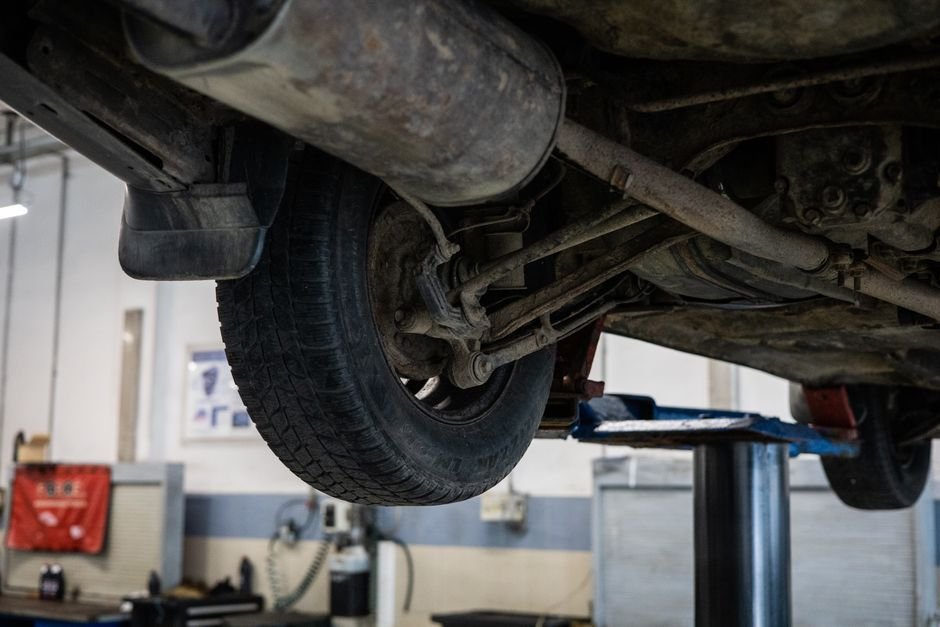
A leaking shock is the clearest sign of all — a wet, oily film on the shaft means the seal has failed, and it needs replacing with no test required. Short of a visible leak, a shop can put the car on a lift and check for play, uneven wear, and worn bushings in a few minutes. Given how much shocks and struts affect stopping distance and handling in an emergency, as documented in vehicle safety research from groups like the Insurance Institute for Highway Safety, that’s a cheap way to rule out a real safety issue before you’re relying on them at highway speed.
Cost is worth planning for ahead of time rather than discovering at the counter. Struts typically run higher than basic shocks because they double as a structural mounting point, and most shops recommend replacing them in pairs — left and right on the same axle — so the car handles evenly on both sides. Replacing only one worn strut can leave a noticeable difference in ride height and cornering feel between the two sides, which is its own kind of handling problem.