Common Mistakes People Make Jump-Starting a Car
Most jump starting a car mistakes come down to one thing: the order you connect the cables. Get the sequence wrong and you risk a spark near battery gases, a fried fuse in the donor car’s electronics, or a battery that still won’t turn over.
The connection order that prevents sparks near the battery
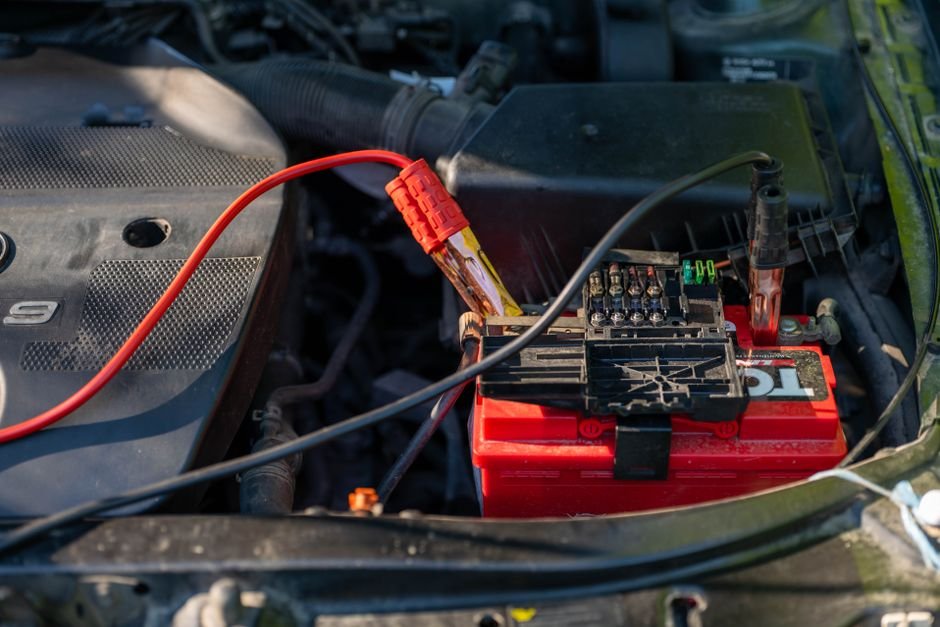
Both cars off, both batteries visible, cables untangled before you touch a terminal. Then:
- Red clamp to the dead battery’s positive terminal
- Red clamp to the donor battery’s positive terminal
- Black clamp to the donor battery’s negative terminal
- Black clamp to an unpainted metal surface on the dead car’s engine block — not the dead battery’s negative post
That last step is the one most people skip, and it’s the one that matters most. Connecting the final clamp directly to the dead battery’s negative terminal puts the spark from that connection right next to a battery that may be venting hydrogen gas. Grounding to the engine block instead moves the spark away from the battery entirely.
Mistakes that damage the car, not just the driver
Reversing polarity — red to negative, black to positive — can blow a fuse or fry sensitive electronics in either vehicle within seconds, sometimes before you notice the mistake. Modern cars pack computers that manage everything from the fuel injectors to the infotainment screen, and a reverse-polarity surge can take out several of them at once on a repair bill that dwarfs a new battery. Double-check the markings on both batteries before any clamp goes on; positive terminals are usually marked with a plus sign and are often, though not always, the larger post. When in doubt, trace the cable back to where it meets the terminal rather than guessing from the clamp color alone.
Leaving the donor car off during the jump is another common one. Starting the dead car off a stationary battery alone works sometimes, but running the donor engine for a couple of minutes first gives a much stronger, steadier charge and a better shot at a first-try start.
Disconnect in reverse order once the dead car is running: black off the engine block, black off the donor, red off the donor, red off the dead battery’s positive terminal. Removing clamps out of order, or letting a stray clamp touch metal while the other end is still connected, is how a lot of avoidable sparks happen.
If a battery needs jumping repeatedly over a few weeks, that’s not a jump-starting problem anymore — it’s a sign the battery itself is failing, which shows up faster in cold weather than most people expect. A cheap multimeter or a five-minute test at most auto parts stores will tell you whether it’s worth replacing before it strands you. The Battery Council International has more detail on safe handling if you want the fuller version before you’re standing in a parking lot doing this from memory.
Worth folding a battery check into your pre-trip routine if the car sits for days at a time — a weak battery rarely announces itself until the moment you need it not to fail.