What a Catalytic Converter Does
A catalytic converter sits in your exhaust system and turns three of the most harmful gases your engine produces into far less harmful ones before they leave the tailpipe. It’s a required emissions part on every gasoline car sold since the 1970s, and it’s also become a common theft target — both facts trace back to what’s actually inside it.
What’s happening inside the converter
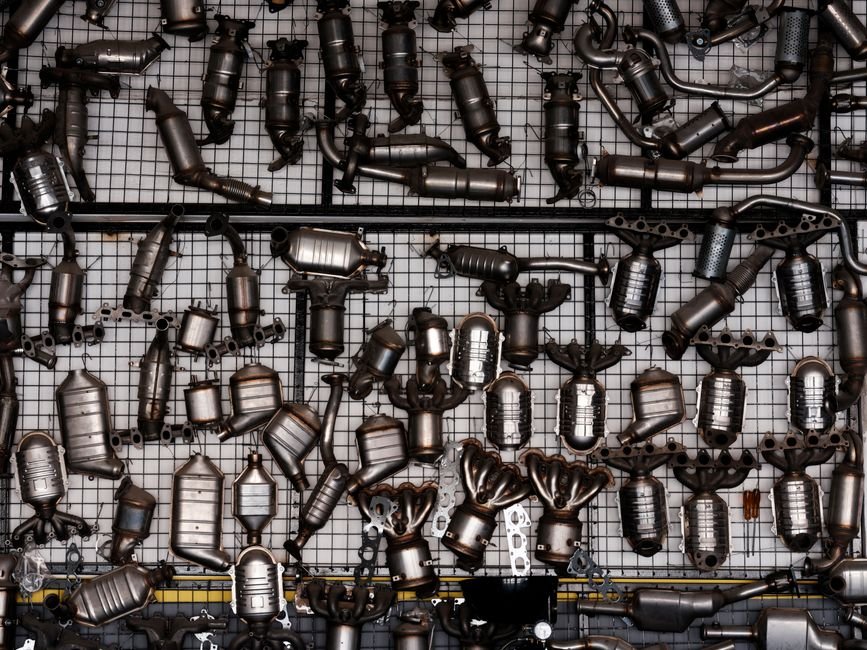
Raw exhaust coming out of an engine contains carbon monoxide, unburned hydrocarbons, and nitrogen oxides, all of which are regulated pollutants. Inside the converter is a ceramic honeycomb structure coated in a thin layer of precious metals — typically platinum, palladium, and rhodium — that act as a catalyst, speeding up a chemical reaction without being consumed by it. As exhaust passes through, those metals convert carbon monoxide and hydrocarbons into carbon dioxide and water vapor, and convert nitrogen oxides back into nitrogen and oxygen.
This only works once the converter reaches operating temperature, usually a few hundred degrees, which is why a car’s emissions are highest in the first few minutes after a cold start. It’s also why short trips are harder on a converter’s effectiveness than longer ones — the unit barely warms up before the engine shuts off again.
Why it’s a theft target
Platinum, palladium, and rhodium are precious metals with real market value, and a converter can be removed from underneath a parked car in a few minutes with a battery-powered saw. Trucks and SUVs with more ground clearance are common targets simply because there’s more room to work underneath them. Some vehicles, particularly certain hybrid models, use converters with a higher concentration of these metals, which has made them a disproportionate target in some areas.
A few things reduce the odds: parking in a garage or a well-lit area, a welded-on anti-theft shield or cage over the converter, and etching your vehicle identification number onto the unit, which makes it harder for a thief to sell and easier for police to trace if it’s recovered. None of these are guarantees, but they change the calculation for someone looking for an easy target.
If your converter is stolen or fails, you’ll know quickly — the car will be dramatically louder, often with a rattling or roaring sound from underneath, and a fuel economy drop. A failing converter from age or a clogged internal structure tends to show up differently: a check engine light with a specific emissions-related code rather than an obvious noise change, along with reduced power in more severe cases.
Replacement cost varies widely depending on the vehicle and whether the converter is sold as a standalone part or integrated into a larger exhaust manifold assembly, and it varies enough that it’s worth getting a specific quote rather than assuming a number. On an older car, a failed converter is sometimes the deciding factor in whether a repair still makes financial sense, since it’s rarely a repair on its own — it usually means several other things are reaching the end of their service life around the same time. For more on how vehicle emissions systems are regulated, the EPA maintains an overview of vehicle and engine standards.